Cisco Secure Client VPN: How to Connect and Troubleshoot
Learn what Cisco Secure Client VPN does, how to connect, and how to resolve common access problems.
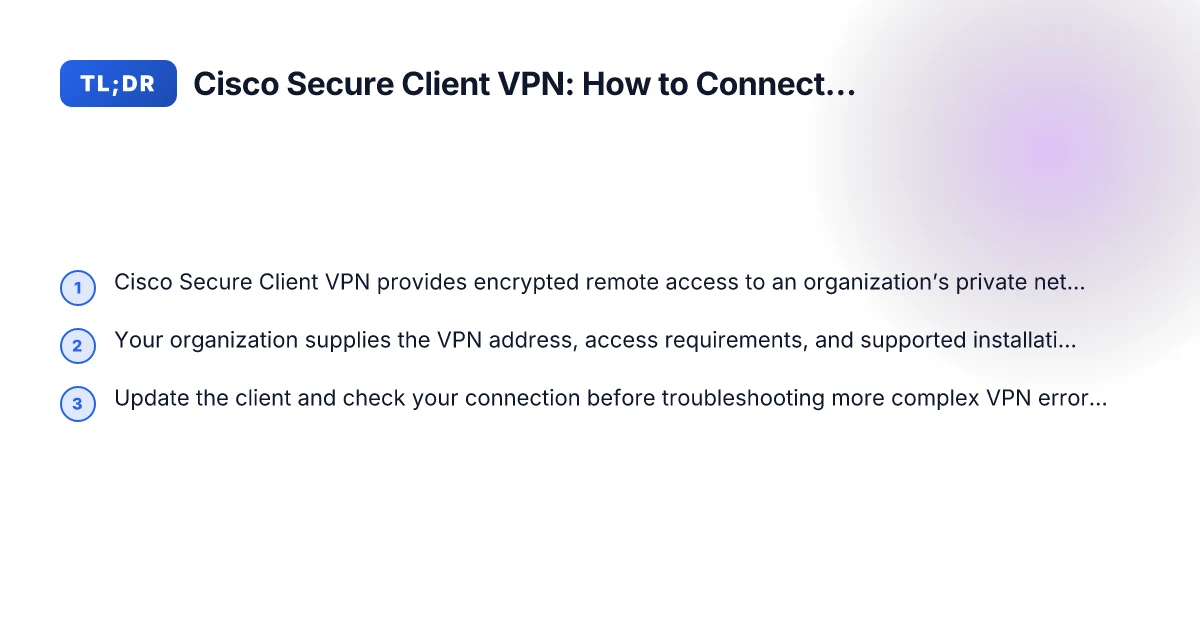
Cisco Secure Client VPN lets authorized users connect securely to an organization’s network from a remote location. To use it, install the client version your organization supports, enter the VPN server address provided by your IT team, and sign in using the required credentials and verification steps. If you cannot connect, check your internet access, account status, and organization-specific instructions first.
Cisco Secure Client is the current name for Cisco AnyConnect Secure Mobility Client. Organizations use it to provide remote access to internal applications and services. The exact setup varies by employer, school, or other network operator, so the VPN address and login process should come from that organization rather than an unofficial website.
| VPN | Obfuscation | From / month | Plan | Free plan | Refund | Alipay | UnionPay | Crypto | Website opens in China | Trustpilot | |
|---|---|---|---|---|---|---|---|---|---|---|---|
 ZoogVPN | Turn on manually Shadow | $2.49/mo | 27 months: $59.99 | Yes | 7 days | ✓ | ✓ | ✓ | ✓ | Official site blocked; our special link opens (4.4 s) | 4.2/5 (195 reviews) |
 NordVPN | Turn on manually Obfuscated Servers / NordWhisper | $3.49/mo | 27 months: $94.23 | No | 30 days | ? | ✗ | ✓ | ✓ | ✗ Blocked | 4.2/5 (51,628 reviews) |
 ExpressVPN | ✓ On by default all servers | $3.00/mo | 28 months: $84 | No | 30 days | ✗ | ✗ | ✓ | ✗ | ✗ Blocked | 4.4/5 (29,706 reviews) |
 Surfshark | ✓ On by default Camouflage, with OpenVPN | See site | See site | No | 30 days | ✗ | ✗ | ✗ | ✓ | ✗ Blocked | 4.3/5 (31,823 reviews) |
 Proton VPN | Turn on manually Stealth, free plan too | $2.99/mo | 12 months: $35.88 | Yes | 30 days | ✗ | ✗ | ✗ | ✓ | ✗ Blocked | 2.1/5 (1,040 reviews) |
 Astrill VPN | Turn on manually StealthVPN / OpenWeb | $12.50/mo | 24 months: $300 | No | See site | ✗ | ✗ | ✗ | ✓ | ✗ Blocked | 1.3/5 (110 reviews) |
 Private Internet Access | Turn on manually Shadowsocks, OpenVPN only | $2.03/mo | 40 months: $81.2 | No | 30 days | ✗ | ✗ | ✗ | ✗ | ✗ Blocked | 4.2/5 (11,033 reviews) |
 CyberGhost | Turn on manually selected servers | $2.19/mo | 28 months: $61.32 | No | 45 days | ✗ | ✗ | ✗ | ✓ | ✗ Blocked | 4.0/5 (24,178 reviews) |
 PureVPN | Turn on manually switch to OpenVPN | $1.69/mo | 60 months: $101.55 | No | 31 days | ? | ? | ✗ | ✓ | ✗ Blocked | 4.4/5 (17,994 reviews) |
 AdGuard VPN | ✓ On by default TrustTunnel | $2.99/mo | 24 months: $71.76 | Yes | 30 days | ✓ | ✗ | ✓ | ✓ | Official site blocked; our special link opens (3.7 s) | 4.3/5 (290 reviews) |
 Mullvad | Turn on manually QUIC / Shadowsocks / LWO | $5.61/mo | €5/mo | No | 14 days | ✗ | ✗ | ✗ | ✓ | ✗ Blocked | 3.2/5 (192 reviews) |
 Windscribe | Turn on manually Stealth / WStunnel | $5.75/mo | 12 months: $69 | Yes | See site | ✗ | ✗ | ✗ | ✓ | ✗ Blocked | 4.7/5 (13,355 reviews) |
 StrongVPN | Turn on manually Scramble, OpenVPN TCP | See site | See site | No | 30 days | ✓ | ✗ | ✗ | ✗ | ✗ Blocked | 4.4/5 (2,695 reviews) |
 LightXtreme 闪连 | Not listed | $7.08/mo | 12 months: $84.99 | Yes | 30 days | ✓ | ✓ | ✓ | ✓ | ✓ Yes (3.5 s) | No page |
Prices checked 2026-11-10 on each vendor's pricing page (cheapest long plan, USD). Check the vendor's checkout for the final price.
Obfuscation checked 2026-11-14 on each vendor's site and help center: "on by default" = nothing to set; "turn on manually" = switch protocol or mode in settings; "not listed" = the vendor describes no obfuscation.
Payment methods checked 2026-11-10 on each vendor's payment pages: all 14 take cards and PayPal; ✗ = not listed, ? = the vendor's own pages disagree.
China access: whether the official website opens from mainland China networks (tests the website only, not the VPN connection). Last checked 2026-11-18 01:02 Beijing time.
Trustpilot score and review count checked 2026-11-10.
Common ways to connect with Cisco Secure Client VPN
| Connection option | What you need | Setup | Best for | Watch for |
|---|---|---|---|---|
| Organization-provided profile | Profile from your organization | Import or select the profile | Managed devices | Use the approved profile |
| Organization-provided server address | VPN server address and sign-in details | Enter the address in the client | First-time setup | Verify the address with IT |
| Single sign-on | Organization account and configured access | Sign in through the organization’s prompt | Centralized authentication | Follow any extra sign-in prompts |
| Multi-factor authentication | Organization account and enrolled factor | Approve the requested verification | Added account protection | Keep the factor available |
| Remote access | Internet connection and authorized account | Connect from outside the organization | Off-site work | Internet access is required |
| On-site access | Organization network access | Connect if your organization requires it | Internal network use | VPN may not be needed on-site |
Compiled November 2026; check the provider's site for current details.
What Cisco Secure Client VPN does
A virtual private network, or VPN, creates an encrypted connection between your device and a network gateway. Once connected, you may be able to reach resources that are not available on the public internet, such as internal websites, file shares, or business applications.
Cisco Secure Client can include more than VPN functionality. Depending on how an organization deploys it, the installation may also provide additional security or network features. Available features and settings are controlled by the organization’s IT administrators.
A VPN connection does not make every online activity anonymous, nor does it replace good account security. Your organization may log network activity on its systems, and websites or services you use may still identify you through your account or browser.
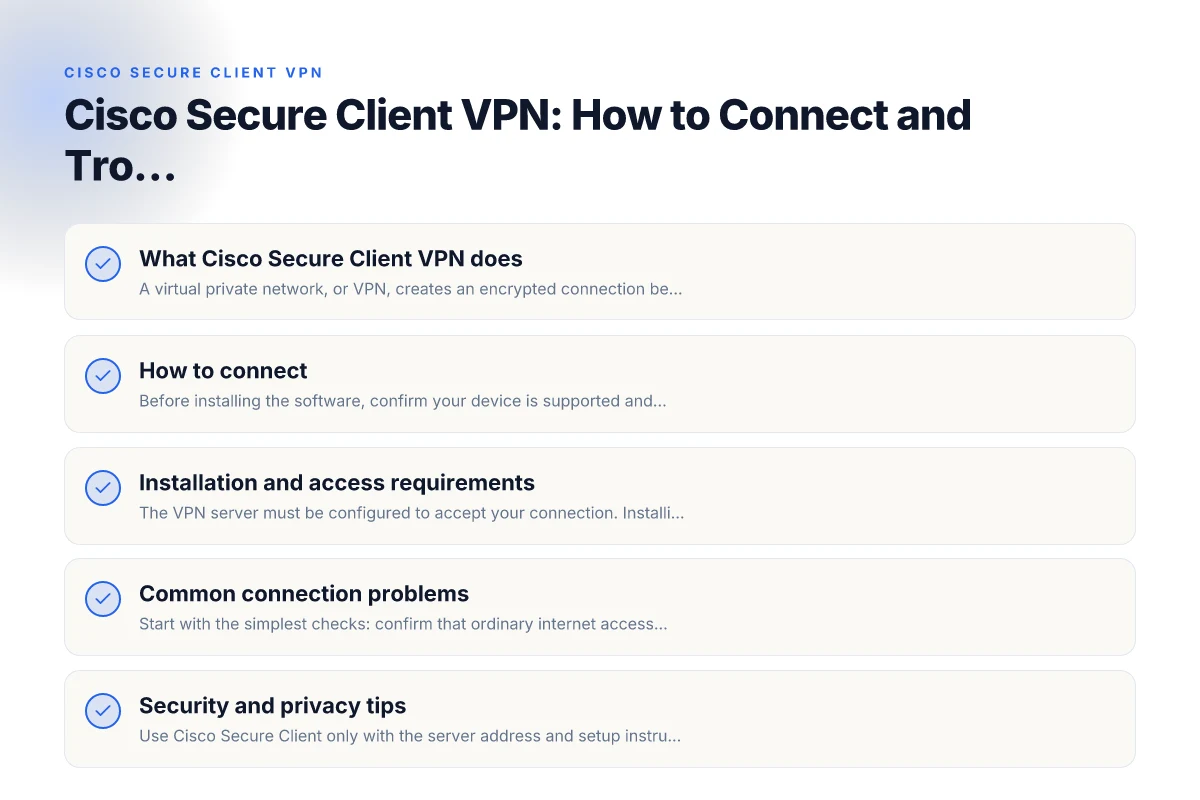
How to connect
Before installing the software, confirm your device is supported and follow your organization’s instructions. Some organizations provide a managed installation through a company portal, while others direct users to an official Cisco download or an approved app store. VPN for Microsoft Edge: How to Choose and Use One
A typical connection process is:
- Install the approved client. Use the installer or app source recommended by your IT team. Avoid third-party download sites.
- Open Cisco Secure Client. Depending on the installation, the VPN option may appear in the app or as a separate VPN interface.
- Enter the VPN address. Type the server address supplied by your organization. It may be a web-style address, but do not guess it.
- Select Connect. Review any organization-provided profile or connection instructions if prompted.
- Sign in and verify your identity. Enter your work or school credentials and complete multifactor authentication if required.
- Confirm the connection. Look for a connected status in the client and check whether the internal resource you need is available.
Some organizations require you to connect to their VPN before opening particular apps. Others use split tunneling, which sends only selected traffic through the VPN. Follow your organization’s guidance rather than changing advanced settings yourself.
Troubleshooting connection problems
| Symptom | Likely area to check | First step | When to contact IT | Avoid |
|---|---|---|---|---|
| Client will not open | Installation or device compatibility | Restart and reopen the client | It still fails to launch | Installing unofficial copies |
| Server cannot be reached | Internet or server address | Check internet and confirm the address | Address is correct but unavailable | Guessing server addresses |
| Sign-in is rejected | Credentials or account access | Re-enter credentials carefully | Account may be locked or unauthorized | Repeatedly guessing passwords |
| Verification does not arrive | Multi-factor setup or delivery | Check the enrolled method | The method is unavailable | Sharing verification codes |
| Connection drops | Network stability or client state | Try a stable network and reconnect | Drops continue | Using an untrusted network |
| Internal resources remain unavailable | Access permissions or network routing | Confirm VPN shows connected | Connection is active but access fails | Changing security settings |
| Client reports an error | Client configuration or service | Note the message and restart the client | Error persists | Deleting managed settings |
Compiled November 2026; check the provider's site for current details. Where Is My VPN? How to Find and Check Your VPN Connection
Installation and access requirements
The VPN server must be configured to accept your connection. Installing the client alone does not grant access: you generally need an active account, authorization from the organization, and the correct server address.
| Item | What to check |
|---|---|
| Device | Confirm your operating system and version are supported. |
| Client | Use the organization’s approved version and installation method. |
| VPN address | Get the exact address from your IT team or official setup guide. |
| Account | Make sure your account is active and permitted to use remote access. |
| Verification | Have access to any required authenticator, security key, or approval method. |
| Network | Use a working internet connection that allows the VPN connection. |
If you are using a personally owned device, your organization may require security checks, device enrollment, or specific permissions. If a setup prompt is unfamiliar, pause and check with IT instead of approving or changing settings without understanding them.
Common connection problems
Start with the simplest checks: confirm that ordinary internet access works, re-enter the VPN address exactly as provided, and verify your username and password. If your organization uses multifactor authentication, make sure you can receive or approve the sign-in request.
Common issues include: iPhone Clash: How to Fix App Conflicts, Crashes, and Performance Problems
- “Unable to connect” or a timeout: The internet connection may be unstable, the VPN gateway may be unavailable, or a network may be blocking the connection. Try a trusted alternate network if your organization permits it.
- Authentication failure: Check your credentials, account status, and multifactor prompts. Repeated attempts may trigger a temporary account lockout.
- Client or connection errors after an update: Restart the device and confirm that the installed client is supported by your organization.
- VPN connects, but internal resources do not load: The resource may be down, your account may lack permission, or the organization’s DNS or routing configuration may need attention.
- Unexpected security or certificate warning: Do not bypass the warning. Contact your IT team, especially if the server address or network has changed.
When contacting support, include your operating system, the client version, the time the problem occurred, the exact error message, and whether you were able to connect previously. Do not send your password or one-time verification code.
Security and privacy tips
Use Cisco Secure Client only with the server address and setup instructions provided by your organization. Keep your operating system and VPN client updated, protect your account with multifactor authentication when available, and disconnect when you no longer need remote access if your organization recommends doing so.
Avoid installing a configuration file or certificate from an unknown source. Do not share screenshots or logs publicly if they reveal internal server names, usernames, or other sensitive details. If you suspect that your account or device has been compromised, report it through your organization’s approved security channel.
Security and access choices VPN Extension for Edge Browser: How to Choose and Use One
| Choice | Access requirement | Security benefit | User action | Consideration |
|---|---|---|---|---|
| Organization-approved client | Authorized download source | Reduces risk of tampered software | Install the approved version | Follow IT instructions |
| Managed VPN profile | Organization-provided configuration | Uses approved connection settings | Keep the profile unchanged | Ask IT before editing |
| Multi-factor authentication | Enrolled verification method | Adds a sign-in check | Approve only expected prompts | Never share codes |
| Trusted network | Known, protected internet access | Lowers exposure to unsafe networks | Prefer trusted Wi-Fi | Public networks need extra care |
| Secure device | Updated operating system and client | Helps address known security issues | Install approved updates | Follow organization policy |
| Disconnect when finished | Active VPN session | Limits unnecessary connected time | Disconnect after use | Reconnect when remote access is needed |
| Privacy-conscious use | Organization VPN policy | Clarifies what VPN traffic is covered | Review the policy | VPN use does not guarantee anonymity |
Compiled November 2026; check the provider's site for current details.
Recommendation
For a reliable setup, use the Cisco Secure Client version and VPN address supplied by your organization, then follow its sign-in and security requirements. If the client will not connect after basic checks, contact your IT help desk with the error details rather than guessing at server settings or bypassing security warnings.