Clash Free: What It Means and How to Prevent Conflicts
Learn what “clash free” means and how to avoid scheduling, design, and digital conflicts with practical checks.
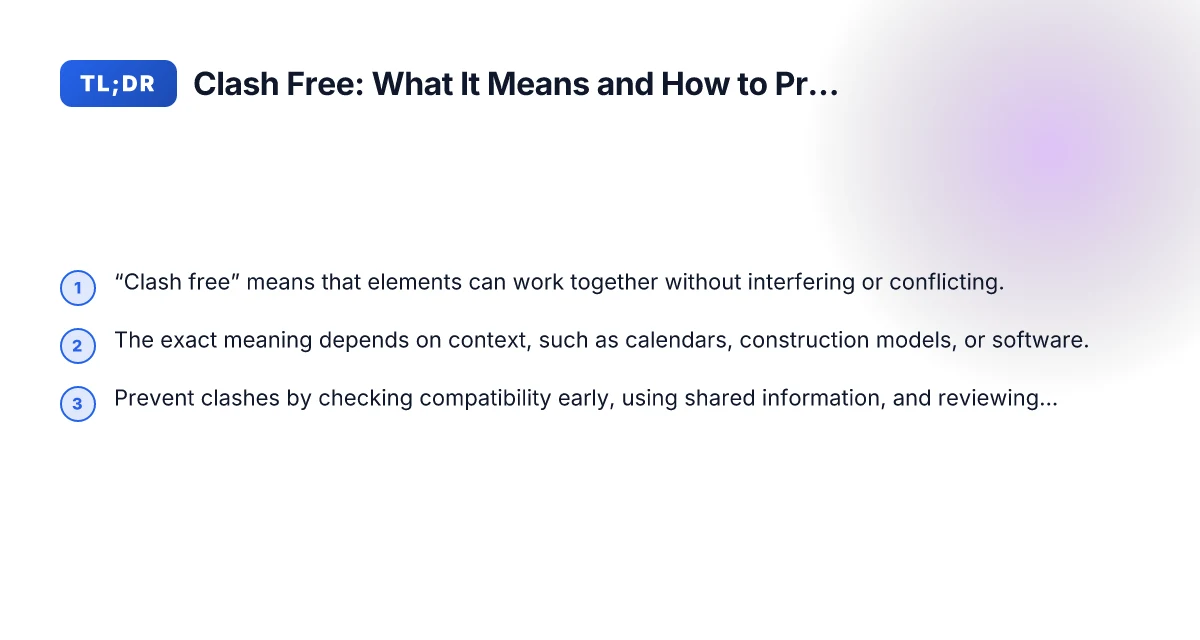
“Clash free” means free from conflicts or interference. What counts as a clash depends on the situation: two calendar events may overlap, building components may occupy the same space, or software and devices may not work together. To make a process clash free, identify what needs to coexist, check for conflicts before they cause problems, and resolve issues through clear coordination.
The phrase is often used as a practical goal rather than a guarantee. A clash-free plan or system is one that has been checked against relevant requirements and has no known conflicts. Here’s how the term applies in common settings and how to achieve that result.
Compare common uses of “clash free”
| Context | What can clash | Typical prevention | What “clash free” suggests |
|---|---|---|---|
| Construction | Building systems or components | Coordination and model checks | Fewer detected design conflicts |
| Interior design | Colors, materials, or styles | Review samples and layouts | Elements work well together |
| Calendars | Events and appointments | Check availability before booking | No overlapping commitments |
| Team planning | Tasks, deadlines, or resources | Assign owners and coordinate schedules | Plans do not compete |
| Software | Programs, versions, or dependencies | Check requirements and test | Components work together |
| Devices | Hardware, drivers, or operating systems | Verify compatibility information | Supported combination |
| Everyday use | Plans, needs, or preferences | Communicate and adjust | No apparent conflict |
Compiled November 2026; check the provider's site for current details.
What does “Clash free” mean?
A clash occurs when two or more things conflict, overlap, or prevent one another from working as intended. A clash-free arrangement avoids those incompatibilities.
The term can refer to:
- Scheduling: Meetings, appointments, or deadlines do not overlap in a way that creates a problem.
- Construction and design: Building elements do not occupy conflicting spaces or obstruct one another.
- Technology: Devices, applications, or components are compatible and can operate together.
- Writing and publishing: A name, phrase, image, or design does not conflict with another usage or requirement.
“Clash free” does not always mean that nothing overlaps. For example, two events may share a time slot if they involve different people and rooms. The important question is whether the overlap creates a real conflict under the rules or needs of that situation.
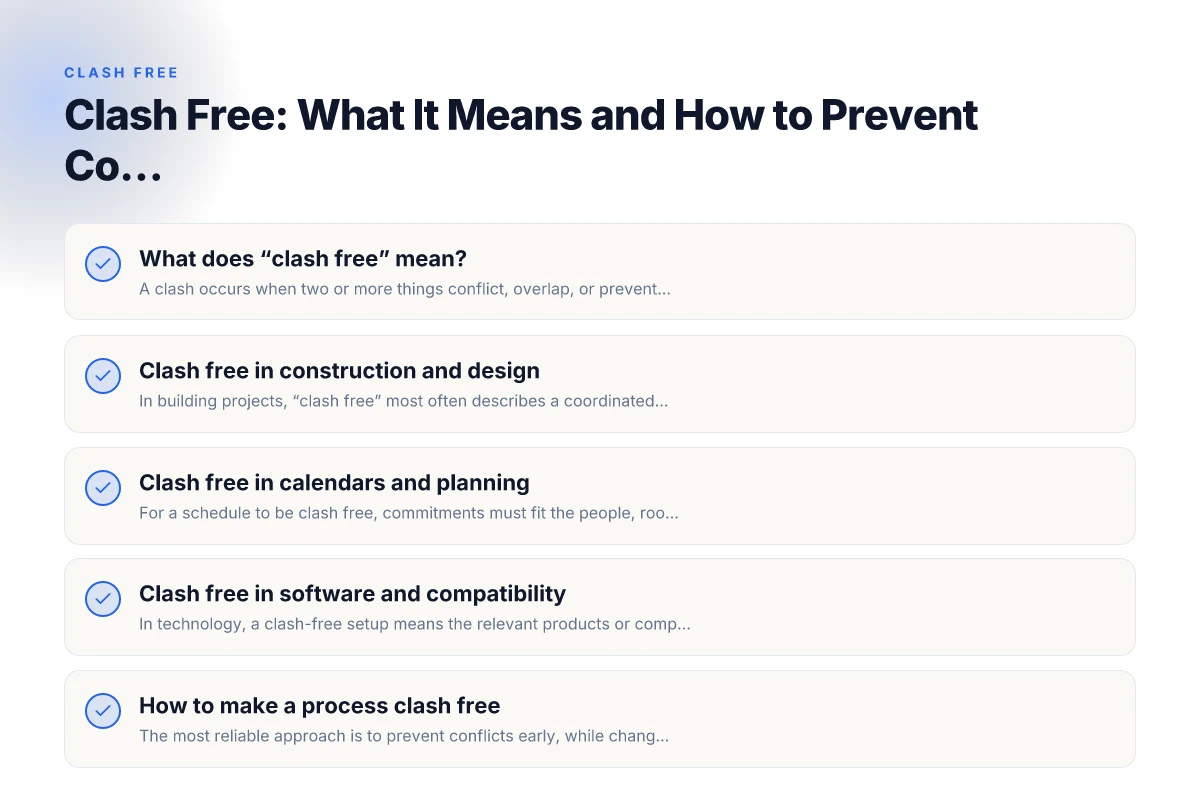
Clash free in construction and design
In building projects, “clash free” most often describes a coordinated design. Architects, engineers, and contractors work with drawings or digital models to check that building components fit together as planned. FortiGate IPsec VPN: Setup, Configuration, and Troubleshooting
A physical clash might happen when a ventilation duct passes through a beam, a pipe occupies the space needed for electrical wiring, or a ceiling fixture conflicts with another system. Detecting these issues in advance can reduce redesign, delays, and costly changes on site.
Common Clash categories
- Hard clashes: Two physical elements occupy the same space.
- Clearance clashes: An element does not leave enough room for access, maintenance, or safe operation.
- Workflow or sequence clashes: Work planned by one team interferes with the timing or access needs of another.
Digital coordination tools can flag possible conflicts, but a flag is not always a confirmed problem. Some overlaps are intentional, and some issues require a human reviewer to understand the design and project requirements. Teams should review results, assign responsibility, and document how each issue is resolved.
Clash free in calendars and planning
For a schedule to be clash free, commitments must fit the people, rooms, resources, and deadlines involved. A calendar that shows no overlapping events may still hide a conflict if travel time, preparation, or setup has not been included.
Use a consistent planning process: FortiClient VPN: What It Does, How to Connect, and What to Know
- Add the correct time zone and duration for each commitment.
- Include travel, setup, preparation, and recovery time where needed.
- Check the availability of participants and shared resources.
- Confirm important changes with everyone affected.
- Review the schedule again after changes are made.
Shared calendars are useful because they give people a common view of availability. However, privacy settings, outdated entries, and separate booking systems can leave gaps. For important appointments or events, confirm the details directly rather than relying only on a calendar display.
Clash free in software and compatibility
In technology, a clash-free setup means the relevant products or components can work together without causing errors or unwanted interference. Compatibility can involve operating systems, software versions, device standards, browser support, or hardware requirements.
Before combining tools or installing an update, check:
- Supported operating systems and versions
- Required hardware, memory, and storage
- File formats and data exchange options
- Known conflicts with other applications or extensions
- Whether the change can be tested or reversed
Compatibility information can change as products are updated. A setup that worked previously may become unreliable after a new release, so teams should test significant changes in a safe environment and keep backups of important data. VPN for Microsoft Edge Free: Safe Options and What to Know
| Context | Typical clash | Useful prevention |
|---|---|---|
| Calendar | Overlapping commitments or unavailable rooms | Check availability, time zones, and buffer time |
| Construction | Building elements occupy the same space | Coordinate models and review flagged issues |
| Software | Incompatible versions or conflicting tools | Check requirements and test updates |
| Publishing | Conflicting names, assets, or usage rules | Review permissions, guidelines, and existing uses |
Choose a clash-prevention approach
| Situation | Useful check | Best time to check | Who should be involved | Limitation |
|---|---|---|---|---|
| Building design | Review coordinated models | During design | Designers and engineers | Depends on model accuracy |
| Construction updates | Recheck affected systems | After design changes | Project team | New changes can introduce clashes |
| Interior choices | Compare samples and layouts | Before purchase | Designer and client | Preferences may differ |
| Calendar booking | Check shared availability | Before sending an invite | Attendees or scheduler | Calendars may be incomplete |
| Project planning | Review deadlines and dependencies | At planning and update points | Owners and managers | Priorities can change |
| Software installation | Check versions and requirements | Before installation | User or IT team | Updates can change compatibility |
| Device setup | Confirm supported hardware and drivers | Before setup | User or support team | Support does not prevent every issue |
Compiled November 2026; check the provider's site for current details.
How to make a process Clash free
The most reliable approach is to prevent conflicts early, while changes are still easy to make. Start by defining what “no clash” means for the project. A design review may focus on physical space and access. A scheduling review may focus on people and resources. Without clear criteria, teams may use the same phrase while checking for different problems.
Then establish one dependable source of information. This could be a shared calendar, a coordinated project model, or a maintained compatibility list. Agree on who updates it and how changes are communicated. When information lives in multiple disconnected places, people can unknowingly work from outdated versions. NordVPN Login: How to Sign In and Fix Common Account Issues
Finally, review exceptions rather than assuming every warning is either harmless or critical. Record the issue, decide whether it affects the project, and note the resolution. A simple tracking list can include the description, owner, due date, status, and decision.
Is “Clash free” a guarantee?
Usually, no. It means that no relevant clashes were identified during a particular check, using the information and criteria available at that time. It cannot guarantee that every future change, hidden constraint, or unusual situation has been considered.
For a meaningful claim, specify the scope: what was checked, when it was checked, which rules were applied, and who reviewed the results. This is especially important in construction, procurement, event planning, and other settings where missed conflicts can affect safety, cost, or delivery.
Assess what a “clash free” claim means Urban VPN Extension: Features, Setup, and What to Consider
| Claim or check | What it can establish | What it cannot establish | Follow-up |
|---|---|---|---|
| No clashes detected | Checks found no conflicts | That no conflict exists | Review scope and results |
| Model coordination completed | Models were coordinated | That all inputs were correct | Confirm current versions |
| Calendar shows no overlap | Listed events do not overlap | That every commitment is listed | Verify availability |
| Compatibility listed | A combination is stated as supported | That every setup will work | Check versions and conditions |
| Test passed | The tested case worked | That untested cases will work | Test relevant scenarios |
| Design review completed | A review took place | That preferences are aligned | Confirm with stakeholders |
| Process described as clash free | A goal or status is being claimed | A permanent guarantee | Ask what was checked and when |
Compiled November 2026; check the provider's site for current details.
Recommendation
Treat “clash free” as an outcome of an ongoing review, not a one-time promise. Define the conflicts that matter, use current shared information, check compatibility or availability early, and review again whenever something changes. This practical approach helps reduce surprises and makes coordination clearer for everyone involved.