VPN Extension for Microsoft Edge: How to Choose and Use One
Learn how Edge VPN extensions work, what they protect, and how to choose a reliable option for safer browsing.
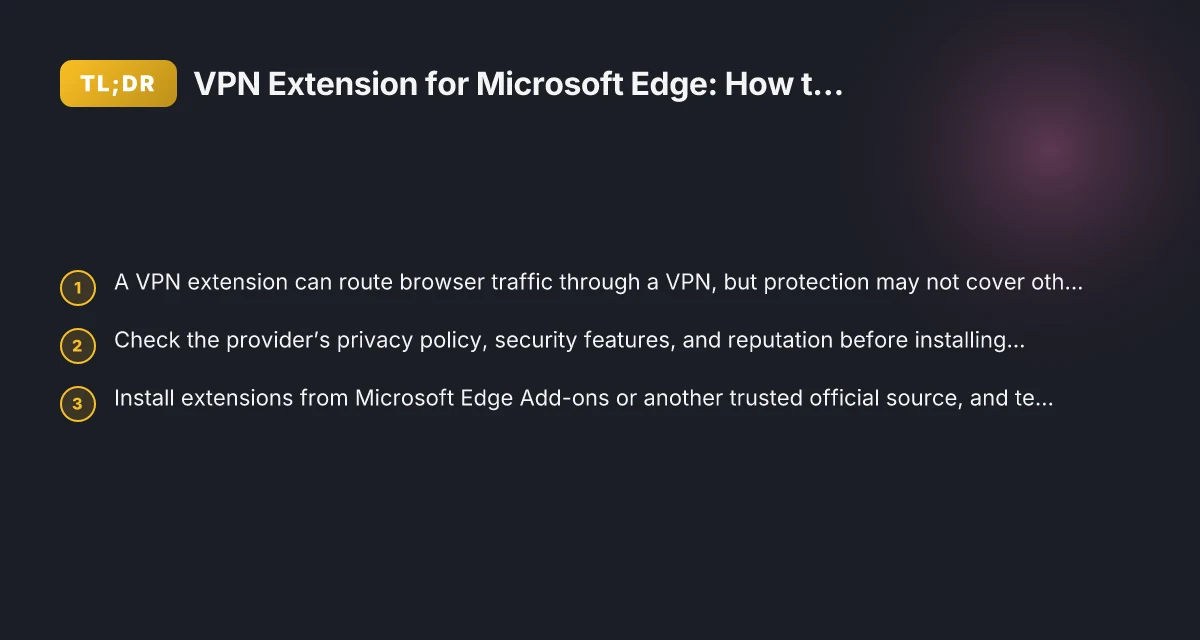
A VPN extension for Microsoft Edge can help protect browser traffic and change the apparent location of your web connection. To use one, choose a reputable VPN provider, install its official Edge extension, sign in, and connect to a server. Keep in mind that many browser extensions protect only traffic from the browser, not every app or connection on your device.
Comparing an Edge VPN extension with a full VPN app
| Feature | Edge VPN extension | Full VPN app |
|---|---|---|
| What it protects | Browser traffic | Device traffic |
| Coverage | Microsoft Edge | Supported device apps |
| Setup | Add to Edge | Install on device |
| Browser use | Yes | Yes |
| Other apps | No | Yes |
| System settings | Limited | Broader |
| Best for | Browser-only privacy | Device-wide protection |
Compiled November 2026; check the provider's site for current details.
| VPN | Obfuscation | From / month | Plan | Free plan | Refund | Alipay | UnionPay | Crypto | Website opens in China | Trustpilot | |
|---|---|---|---|---|---|---|---|---|---|---|---|
 ZoogVPN | Turn on manually Shadow | $2.49/mo | 27 months: $59.99 | Yes | 7 days | ✓ | ✓ | ✓ | ✓ | Official site blocked; our special link opens (4.4 s) | 4.2/5 (195 reviews) |
 NordVPN | Turn on manually Obfuscated Servers / NordWhisper | $3.49/mo | 27 months: $94.23 | No | 30 days | ? | ✗ | ✓ | ✓ | ✗ Blocked | 4.2/5 (51,628 reviews) |
 ExpressVPN | ✓ On by default all servers | $3.00/mo | 28 months: $84 | No | 30 days | ✗ | ✗ | ✓ | ✗ | ✗ Blocked | 4.4/5 (29,706 reviews) |
 Surfshark | ✓ On by default Camouflage, with OpenVPN | See site | See site | No | 30 days | ✗ | ✗ | ✗ | ✓ | ✗ Blocked | 4.3/5 (31,823 reviews) |
 Proton VPN | Turn on manually Stealth, free plan too | $2.99/mo | 12 months: $35.88 | Yes | 30 days | ✗ | ✗ | ✗ | ✓ | ✗ Blocked | 2.1/5 (1,040 reviews) |
 Astrill VPN | Turn on manually StealthVPN / OpenWeb | $12.50/mo | 24 months: $300 | No | See site | ✗ | ✗ | ✗ | ✓ | ✗ Blocked | 1.3/5 (110 reviews) |
 Private Internet Access | Turn on manually Shadowsocks, OpenVPN only | $2.03/mo | 40 months: $81.2 | No | 30 days | ✗ | ✗ | ✗ | ✗ | ✗ Blocked | 4.2/5 (11,033 reviews) |
 CyberGhost | Turn on manually selected servers | $2.19/mo | 28 months: $61.32 | No | 45 days | ✗ | ✗ | ✗ | ✓ | ✗ Blocked | 4.0/5 (24,178 reviews) |
 PureVPN | Turn on manually switch to OpenVPN | $1.69/mo | 60 months: $101.55 | No | 31 days | ? | ? | ✗ | ✓ | ✗ Blocked | 4.4/5 (17,994 reviews) |
 AdGuard VPN | ✓ On by default TrustTunnel | $2.99/mo | 24 months: $71.76 | Yes | 30 days | ✓ | ✗ | ✓ | ✓ | Official site blocked; our special link opens (3.7 s) | 4.3/5 (290 reviews) |
 Mullvad | Turn on manually QUIC / Shadowsocks / LWO | $5.61/mo | €5/mo | No | 14 days | ✗ | ✗ | ✗ | ✓ | ✗ Blocked | 3.2/5 (192 reviews) |
 Windscribe | Turn on manually Stealth / WStunnel | $5.75/mo | 12 months: $69 | Yes | See site | ✗ | ✗ | ✗ | ✓ | ✗ Blocked | 4.7/5 (13,355 reviews) |
 StrongVPN | Turn on manually Scramble, OpenVPN TCP | See site | See site | No | 30 days | ✓ | ✗ | ✗ | ✗ | ✗ Blocked | 4.4/5 (2,695 reviews) |
 LightXtreme 闪连 | Not listed | $7.08/mo | 12 months: $84.99 | Yes | 30 days | ✓ | ✓ | ✓ | ✓ | ✓ Yes (3.5 s) | No page |
Prices checked 2026-11-10 on each vendor's pricing page (cheapest long plan, USD). Check the vendor's checkout for the final price.
Obfuscation checked 2026-11-14 on each vendor's site and help center: "on by default" = nothing to set; "turn on manually" = switch protocol or mode in settings; "not listed" = the vendor describes no obfuscation.
Payment methods checked 2026-11-10 on each vendor's payment pages: all 14 take cards and PayPal; ✗ = not listed, ? = the vendor's own pages disagree.
China access: whether the official website opens from mainland China networks (tests the website only, not the VPN connection). Last checked 2026-11-18 01:02 Beijing time.
Trustpilot score and review count checked 2026-11-10.
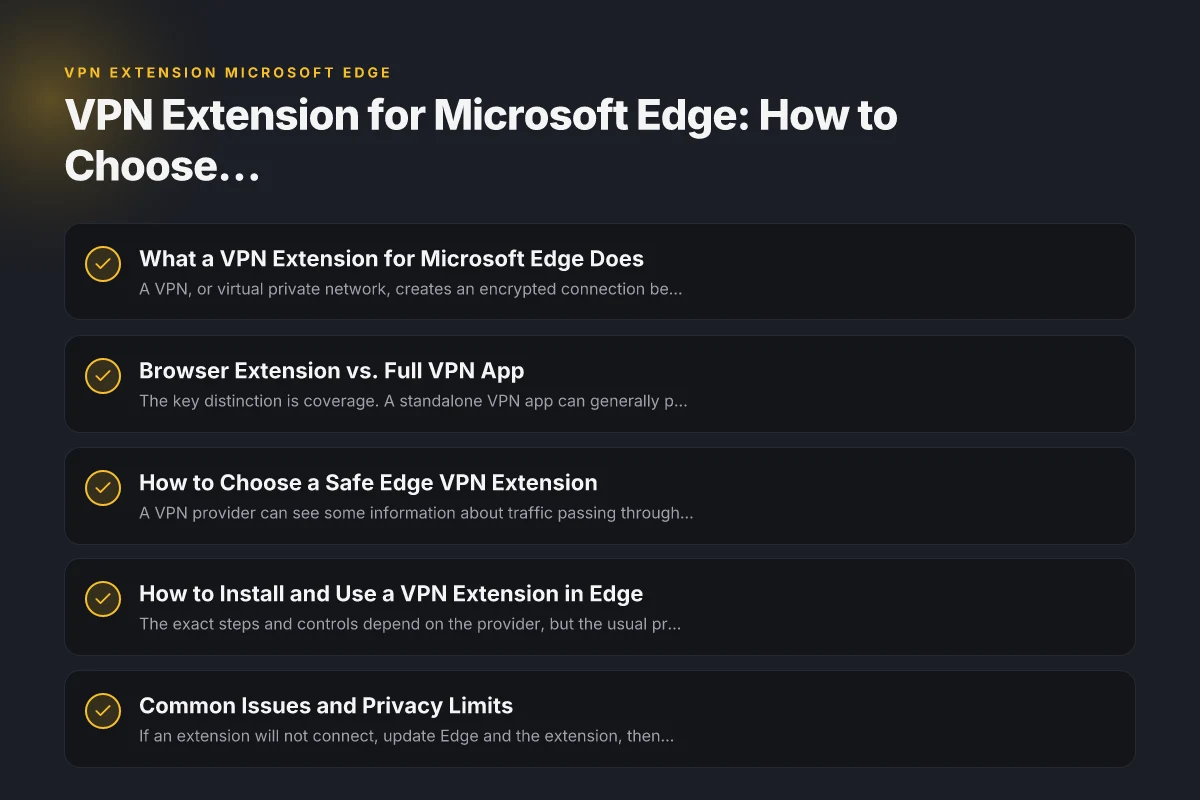
What a VPN Extension for Microsoft Edge Does
A VPN, or virtual private network, creates an encrypted connection between your device and a VPN server. A browser extension provides a way to manage VPN features from Microsoft Edge. Depending on the service, it may route Edge traffic through the provider’s network, helping protect information in transit and masking your usual IP address from websites.
Extensions vary. Some are full VPN clients that encrypt browser traffic, while others act as browser proxies or control a VPN app installed on your computer. Read the provider’s description carefully so you know what is being protected.
A browser extension may help when you:
- Want to use a different apparent location for browser sessions.
- Prefer an easy way to connect or switch servers while browsing.
- Want an added layer of privacy on networks you do not control.
A VPN does not make you completely anonymous. Websites may still identify you through account logins, cookies, browser fingerprints, or other information. It also does not replace antivirus software or protect you from every scam or malicious download. Fastest Free VPN for Edge: What to Choose and How to Test It
Browser Extension vs. Full VPN App
The key distinction is coverage. A standalone VPN app can generally protect traffic from more applications on your device. An Edge extension usually focuses on the browser, although some extensions work alongside a desktop app.
| Feature | Edge VPN extension | Full VPN app |
|---|---|---|
| Typical traffic coverage | Microsoft Edge traffic, or traffic managed by the extension | Traffic from most or all device apps |
| How you control it | From the browser toolbar or extension settings | From a desktop or mobile app |
| Useful for | Browser-specific privacy and quick server changes | Broader protection across the device |
| What to verify | Whether it encrypts traffic or uses a proxy | Which apps, protocols, and connections it covers |
Neither format is automatically better for everyone. If you want protection for email, messaging, or other apps outside Edge, look for a full VPN app or confirm that the extension connects to one. If your goal is to manage browser traffic conveniently, an extension may be enough.
Checks for choosing a safer Edge VPN extension
| Check | What to look for | Why it matters | Warning sign |
|---|---|---|---|
| Publisher | Identifiable provider | Helps establish who operates it | Unknown publisher |
| Privacy policy | Clear data practices | Shows how browsing data is handled | Vague or missing policy |
| Permissions | Relevant to VPN features | Limits unnecessary access | Broad, unexplained access |
| Encryption | Clearly described | Helps protect traffic in transit | No clear explanation |
| Logging | Plain-language disclosure | Clarifies what activity is retained | Unclear retention practices |
| Updates | Recent maintenance | Indicates ongoing support | Abandoned extension |
| Reviews | Consistent, credible feedback | Can reveal recurring issues | Repeated privacy complaints |
Compiled November 2026; check the provider's site for current details. VPN PC: How to Choose, Install, and Use a VPN on Your Computer
How to Choose a Safe Edge VPN Extension
A VPN provider can see some information about traffic passing through its service, so trust matters. Avoid choosing an extension based only on a high rating, a large server count, or a promise of unlimited free access.
Before installing, check these points:
- Provider identity: Make sure the extension is published by the VPN company you intend to use.
- Privacy policy: Look for clear information about collected data, connection logs, and how information is shared.
- Security details: Check what traffic the extension protects and whether the provider explains its security practices.
- Reputation: Look for independent reviews and a history of responding to security issues.
- Permissions: Review what the extension requests. Permissions should make sense for the features it offers.
- Pricing and limits: Confirm whether the plan has data caps, server restrictions, or a free trial that converts to a paid subscription.
- Support: Check whether the provider offers clear setup instructions and customer support.
Free services can be legitimate, but some have limits or collect data to support their business. Do not assume that a free VPN provides the same privacy protections as a paid plan. If a provider gives little information about who runs it or how it handles data, choose another option.
How to Install and Use a VPN Extension in Edge
The exact steps and controls depend on the provider, but the usual process is straightforward: FortiClient VPN Japan: How to Connect Safely and Choose the Right Setup
- Open Microsoft Edge and visit the Microsoft Edge Add-ons store.
- Search for the VPN provider’s official extension.
- Check the publisher name, description, reviews, and permissions.
- Select the option to add the extension and confirm the requested permissions.
- Open the extension from the toolbar. If it is not visible, use Edge’s Extensions menu to find or pin it.
- Sign in or create an account if required.
- Choose a server location and connect.
- Confirm the extension indicates that the connection is active.
After connecting, test that it is working. Visit a reputable IP-checking website and compare the displayed location with your usual connection. If the location has not changed, review the extension’s instructions, check whether another VPN is active, and reconnect.
Use the provider’s official website if it directs you to install an extension outside the Edge Add-ons store. Avoid links from unsolicited messages or unfamiliar download sites, and never install a similarly named extension without checking its publisher.
Troubleshooting common Edge VPN extension issues
| Issue | Check | Possible action | Privacy limit |
|---|---|---|---|
| Extension will not connect | Connection status | Reconnect or check settings | Protection may be inactive |
| Websites still show your location | IP location | Confirm the VPN connection | Location signals may vary |
| Some sites do not load | Site compatibility | Temporarily test without extension | Site traffic may be exposed |
| Other apps use your normal connection | App coverage | Use a full VPN app | Extension covers Edge only |
| Extension requests broad access | Permission list | Review before installing | Permissions affect browser data |
| Connection drops | Extension status | Reconnect and verify protection | Traffic may leave the VPN route |
| Privacy remains unclear | Provider policy | Choose a clearer provider | A VPN does not guarantee anonymity |
Compiled November 2026; check the provider's site for current details. FortiClient VPN Windows: Download, Install, and Connect Securely
Common Issues and Privacy Limits
If an extension will not connect, update Edge and the extension, then restart the browser. Check your internet connection, sign out and back in, and try another server. If a desktop VPN app is installed, consult the provider’s instructions. The app and extension may need to be connected in a specific order.
For the best privacy, also consider:
- Keeping Edge and its extensions updated.
- Removing extensions you no longer use.
- Reviewing extension permissions periodically.
- Avoiding sensitive activity on websites that do not use HTTPS.
- Checking what happens if the VPN connection drops.
Some VPN services offer a kill switch, but it may be available only in the desktop app and may not cover browser-extension traffic. Likewise, DNS or WebRTC leaks can sometimes expose information a user expects the VPN to hide. Follow the provider’s guidance for leak testing, and do not assume an extension blocks every tracking method.
Recommendation
Choose a VPN extension for Microsoft Edge from a provider with a clear privacy policy, credible security practices, and an official listing. Use it for browser traffic, and select a full VPN app if you need coverage for other device apps. After installing, verify that it connects and understand exactly what it protects. What Is a Proxy Server? How It Works, Types, and When to Use One