VPN IPsec: How It Works, Benefits, and When to Use It

Learn how VPN IPsec protects network traffic, how it compares with other VPN protocols, and when it is the right choice.
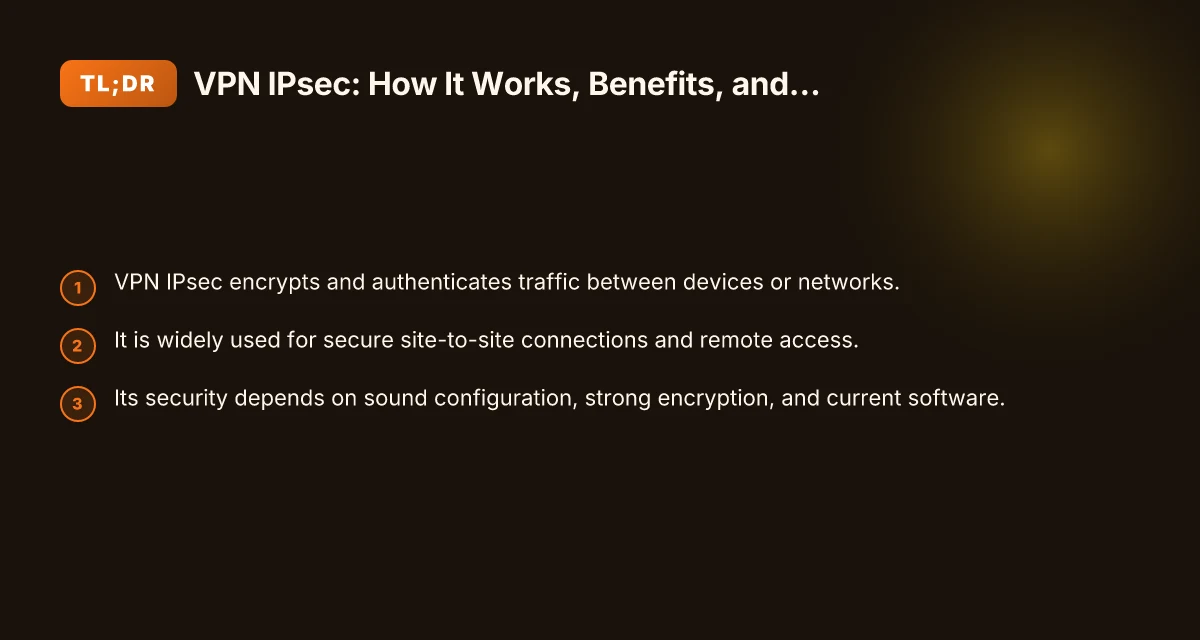
A VPN IPsec connection uses the Internet Protocol Security (IPsec) suite to protect data traveling across an untrusted network. It can encrypt traffic, verify that it came from an authorized source, and help prevent tampering. Businesses commonly use it to connect office networks or give employees secure access to internal resources. Whether it is right for you depends on the devices, network setup, performance needs, and security requirements involved.
How IPsec VPN compares with other VPN options
| Option | Typical use | Security approach | Device support | Setup effort |
|---|---|---|---|---|
| IPsec VPN | Site-to-site or remote access | Network-layer encryption | Broad, often built in | Moderate to high |
| OpenVPN | Remote access | TLS-based encryption | Broad, with client software | Moderate |
| WireGuard | Fast remote access | Modern, streamlined cryptography | Requires compatible software | Low to moderate |
| SSL VPN | Browser-based remote access | TLS encryption | Browser or client | Low to moderate |
| L2TP/IPsec | Legacy remote access | L2TP with IPsec encryption | Broad legacy support | Moderate |
| PPTP | Legacy access only | Outdated encryption | Broad legacy support | Low |
Compiled November 2026; check the provider's site for current details.
| VPN | Obfuscation | From / month | Plan | Free plan | Refund | Alipay | UnionPay | Crypto | Website opens in China | Trustpilot | |
|---|---|---|---|---|---|---|---|---|---|---|---|
 ZoogVPN | Turn on manually Shadow | $2.49/mo | 27 months: $59.99 | Yes | 7 days | ✓ | ✓ | ✓ | ✓ | Official site blocked; our special link opens (4.4 s) | 4.2/5 (195 reviews) |
 NordVPN | Turn on manually Obfuscated Servers / NordWhisper | $3.49/mo | 27 months: $94.23 | No | 30 days | ? | ✗ | ✓ | ✓ | ✗ Blocked | 4.2/5 (51,628 reviews) |
 ExpressVPN | ✓ On by default all servers | $3.00/mo | 28 months: $84 | No | 30 days | ✗ | ✗ | ✓ | ✗ | ✗ Blocked | 4.4/5 (29,706 reviews) |
 Surfshark | ✓ On by default Camouflage, with OpenVPN | See site | See site | No | 30 days | ✗ | ✗ | ✗ | ✓ | ✗ Blocked | 4.3/5 (31,823 reviews) |
 Proton VPN | Turn on manually Stealth, free plan too | $2.99/mo | 12 months: $35.88 | Yes | 30 days | ✗ | ✗ | ✗ | ✓ | ✗ Blocked | 2.1/5 (1,040 reviews) |
 Astrill VPN | Turn on manually StealthVPN / OpenWeb | $12.50/mo | 24 months: $300 | No | See site | ✗ | ✗ | ✗ | ✓ | ✗ Blocked | 1.3/5 (110 reviews) |
 Private Internet Access | Turn on manually Shadowsocks, OpenVPN only | $2.03/mo | 40 months: $81.2 | No | 30 days | ✗ | ✗ | ✗ | ✗ | ✗ Blocked | 4.2/5 (11,033 reviews) |
 CyberGhost | Turn on manually selected servers | $2.19/mo | 28 months: $61.32 | No | 45 days | ✗ | ✗ | ✗ | ✓ | ✗ Blocked | 4.0/5 (24,178 reviews) |
 PureVPN | Turn on manually switch to OpenVPN | $1.69/mo | 60 months: $101.55 | No | 31 days | ? | ? | ✗ | ✓ | ✗ Blocked | 4.4/5 (17,994 reviews) |
 AdGuard VPN | ✓ On by default TrustTunnel | $2.99/mo | 24 months: $71.76 | Yes | 30 days | ✓ | ✗ | ✓ | ✓ | Official site blocked; our special link opens (3.7 s) | 4.3/5 (290 reviews) |
 Mullvad | Turn on manually QUIC / Shadowsocks / LWO | $5.61/mo | €5/mo | No | 14 days | ✗ | ✗ | ✗ | ✓ | ✗ Blocked | 3.2/5 (192 reviews) |
 Windscribe | Turn on manually Stealth / WStunnel | $5.75/mo | 12 months: $69 | Yes | See site | ✗ | ✗ | ✗ | ✓ | ✗ Blocked | 4.7/5 (13,355 reviews) |
 StrongVPN | Turn on manually Scramble, OpenVPN TCP | See site | See site | No | 30 days | ✓ | ✗ | ✗ | ✗ | ✗ Blocked | 4.4/5 (2,695 reviews) |
 LightXtreme 闪连 | Not listed | $7.08/mo | 12 months: $84.99 | Yes | 30 days | ✓ | ✓ | ✓ | ✓ | ✓ Yes (3.5 s) | No page |
Prices checked 2026-11-10 on each vendor's pricing page (cheapest long plan, USD). Check the vendor's checkout for the final price.
Obfuscation checked 2026-11-14 on each vendor's site and help center: "on by default" = nothing to set; "turn on manually" = switch protocol or mode in settings; "not listed" = the vendor describes no obfuscation.
Payment methods checked 2026-11-10 on each vendor's payment pages: all 14 take cards and PayPal; ✗ = not listed, ? = the vendor's own pages disagree.
China access: whether the official website opens from mainland China networks (tests the website only, not the VPN connection). Last checked 2026-11-18 01:02 Beijing time.
Trustpilot score and review count checked 2026-11-10.
What Is VPN IPsec?
IPsec is a collection of standards and protocols for securing IP traffic. A VPN uses these protections to create a private, authenticated connection over a public network, such as the Internet.
IPsec can work in two modes:
- Tunnel mode: Encapsulates and protects an entire IP packet. It is commonly used for site-to-site VPNs, where gateways connect separate networks.
- Transport mode: Protects the data portion of an IP packet while leaving its original IP header visible. It is more common for direct host-to-host connections than for typical commercial VPN services.
The term “VPN IPsec” often refers to an IPsec VPN using Internet Key Exchange (IKE) to negotiate security settings and establish keys. IKEv2 is a widely used version. IPsec itself is not a single encryption algorithm. The connection’s protection depends on which algorithms and settings are selected.
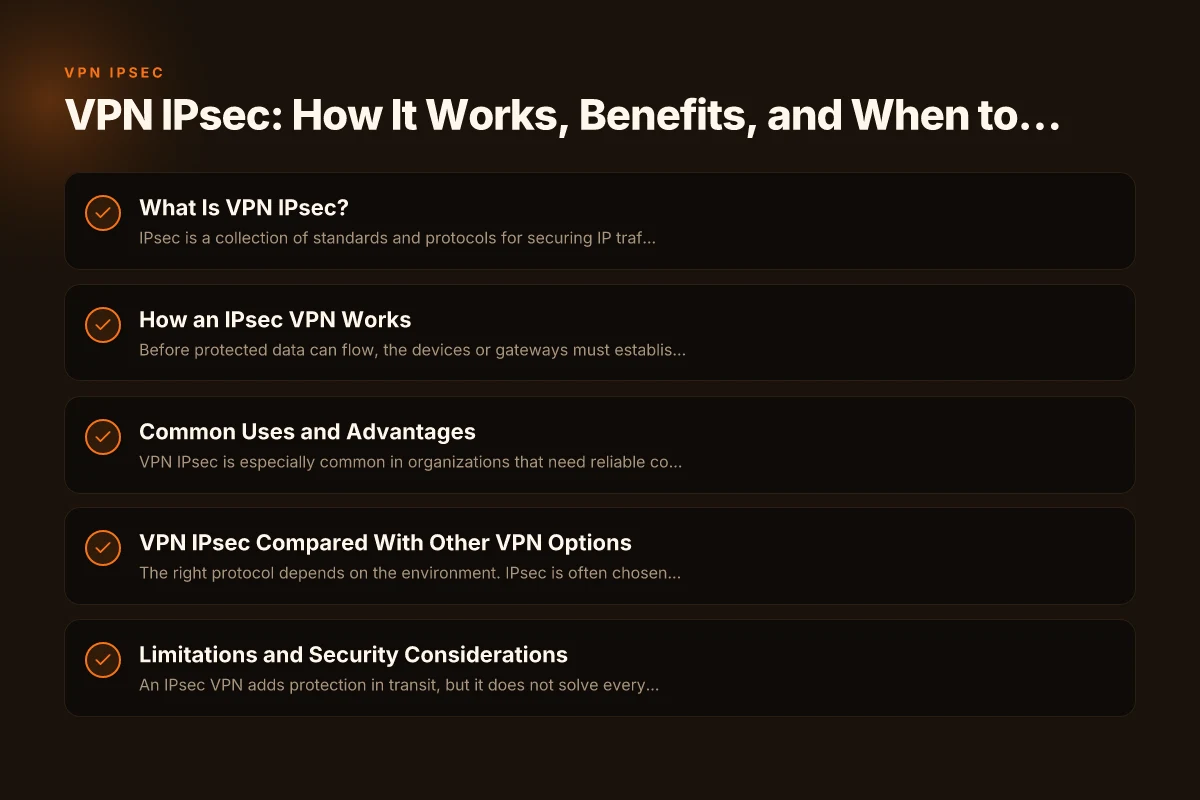
How an IPsec VPN Works
Before protected data can flow, the devices or gateways must establish a secure connection. They authenticate one another, agree on security parameters, and create encryption keys. TunnelBear Extension: What It Does and How to Use It
A typical connection follows these steps:
- Negotiation: The endpoints agree on protocols, encryption algorithms, and other security settings.
- Authentication: They confirm each other’s identity, often with certificates or a pre-shared key.
- Key establishment: IKE securely establishes keys for the connection.
- Protected traffic: IPsec encrypts and authenticates packets according to the negotiated settings.
- Rekeying or disconnection: Keys may be refreshed periodically, and the connection ends when no longer needed or when a device disconnects.
IPsec commonly uses ESP (Encapsulating Security Payload) to provide encryption and integrity protection. AH (Authentication Header) offers authentication and integrity without encryption and is less commonly used. In many modern deployments, ESP is the practical choice.
Because IPsec operates at the network layer, applications generally do not need to be modified to use it. Once the VPN is connected, eligible traffic can be protected automatically.
Choosing an IPsec VPN deployment Clash for iPad: How to Install and Play
| Scenario | IPsec fit | Main benefit | Main consideration |
|---|---|---|---|
| Connecting office networks | Strong | Secure site-to-site links | Requires compatible gateways |
| Remote employee access | Supported | Encrypted access to internal resources | Client configuration may be needed |
| Protecting traffic on public Wi-Fi | Supported | Encrypts network traffic | Does not guarantee anonymity |
| Browser-only access | Limited | Can protect network connections | SSL VPN may be simpler |
| Connecting cloud and on-premises networks | Strong | Encrypted hybrid connectivity | Cloud and gateway settings must align |
| Reaching a single web application | Often excessive | Broad network-level access | Application-specific access may be preferable |
Compiled November 2026; check the provider's site for current details.
Common Uses and Advantages
VPN IPsec is especially common in organizations that need reliable connections between networks. For example, a company can connect its headquarters and branch offices through IPsec tunnels, allowing users at each location to reach approved internal systems.
It is also used for remote access. An employee’s device can establish a secure tunnel to a company gateway, subject to the organization’s authentication and access policies.
Common advantages include: FortiClient VPN Setup: A Step-by-Step Guide for Windows and macOS
- Broad platform support: Many operating systems, routers, firewalls, and VPN gateways support IPsec.
- Network-level protection: It can secure traffic for many applications without configuring each one separately.
- Flexible deployment: It supports both network-to-network tunnels and host-based connections.
- Mature standards: Its protocols have been widely implemented and reviewed over many years.
- Strong authentication options: Deployments can use certificates, managed credentials, or other supported methods.
IPsec is not automatically secure simply because it is enabled. Weak credentials, outdated software, overly broad network access, or obsolete algorithms can undermine a deployment.
VPN IPsec Compared With Other VPN Options
The right protocol depends on the environment. IPsec is often chosen for network gateways and managed devices, while other protocols may be simpler for particular remote-access or consumer use cases.
| Option | Typical use | Strengths | Considerations |
|---|---|---|---|
| IPsec with IKEv2 | Site-to-site and remote-access VPNs | Mature, widely supported, suitable for managed networks | Configuration can be complex; network firewalls may interfere |
| WireGuard | Modern remote access and network tunnels | Lightweight design and generally straightforward performance | Support and management features vary by platform and provider |
| OpenVPN | Remote access and cross-platform deployments | Flexible and widely available | May require additional software and can involve more configuration |
| SSL/TLS-based VPN | Browser-oriented or application access | Can work well for specific remote-access needs | Features and security depend on the product and implementation |
These options are not interchangeable in every setting. A company may use IPsec between gateways but choose a different technology for employee devices. Compare the products’ supported features, management tools, security settings, and compatibility rather than relying on protocol names alone.
Limitations and Security Considerations
An IPsec VPN adds protection in transit, but it does not solve every security problem. It does not, by itself, stop malware on an endpoint, secure a compromised account, or control what an authorized user can access. VPN for Edge Extension: How to Choose and Use One
Setup can also be challenging. The endpoints must agree on compatible settings, and network address translation, firewalls, or restrictive networks may affect connectivity. IPsec deployments commonly use UDP port 500 for IKE and UDP port 4500 for NAT traversal, although exact requirements depend on the configuration.
For a safer deployment:
- Prefer IKEv2 and strong, currently recommended cryptographic settings.
- Use certificates or robust authentication practices. Avoid weak or shared credentials.
- Keep VPN clients, gateways, and operating systems updated.
- Limit access to only the networks and services users need.
- Use multifactor authentication for remote access where supported.
- Monitor connection logs and review access rules regularly.
- Plan key rotation, device revocation, and incident response.
For a consumer VPN service, check the provider’s privacy practices and independent security information too. A VPN can protect data between your device and the VPN server, but it does not make all Internet activity anonymous or guarantee that a provider cannot observe connection metadata.
IPsec VPN limitations and security checks Tuxler VPN Chrome: How It Works, Setup, and What to Know
| Consideration | What to check | Why it matters | Practical response |
|---|---|---|---|
| Protocol configuration | Use current, secure settings | Weak settings can reduce protection | Follow vendor guidance |
| Authentication | Verify identities and credentials | Prevents unauthorized connections | Use strong authentication |
| Key management | Review key rotation and storage | Exposed keys can compromise tunnels | Protect and rotate keys |
| Firewall and NAT | Confirm required traffic is allowed | Misconfiguration can block connections | Test the full network path |
| Endpoint security | Keep devices and gateways updated | VPNs do not fix compromised devices | Patch and monitor endpoints |
| Access scope | Limit permitted networks and users | Broad access increases exposure | Apply least privilege |
| Performance | Check latency and device capacity | Encryption and routing add overhead | Test under expected load |
Compiled November 2026; check the provider's site for current details.
Recommendation
Choose VPN IPsec when you need a standards-based way to secure traffic between networks or managed devices, and your routers, firewalls, and clients support a consistent configuration. For a business deployment, have a qualified administrator select modern settings, enforce strong authentication, restrict access, and maintain the endpoints. For personal use, compare the VPN provider’s supported protocols and privacy practices; IPsec is a solid option, but the quality of the implementation matters more than the protocol label alone.